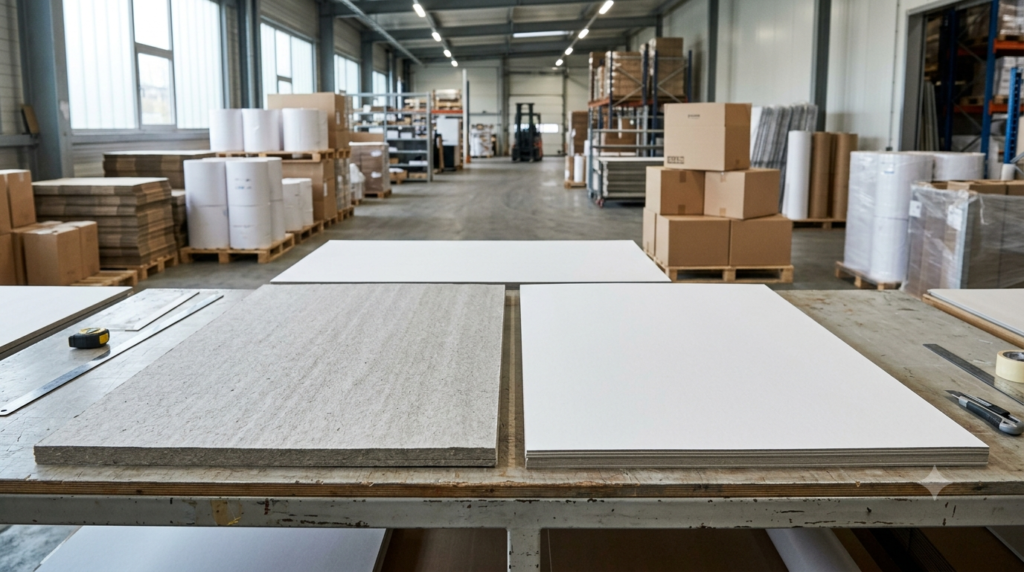
Grey Back vs White Back duplex board — which one is better?
This is a common question among packaging manufacturers, carton manufacturers, printers, pharmaceutical packaging companies, FMCG businesses, cake-box manufacturers and cosmetic box manufacturers.
The short answer is:
Neither Grey Back nor White Back duplex board is universally better. The right choice depends on your packaging application, appearance requirements, printing needs, box construction and budget.
Grey Back duplex board has a grey reverse side, while White Back duplex board has a white reverse side. But the difference is not limited to colour. Buyers should also consider GSM, caliper, stiffness, surface quality, moisture, coating, printing performance and converting requirements.
In this guide, M I Enterprises explains the difference between Grey Back and White Back duplex board in simple terms and helps you decide which one may be suitable for your packaging requirement.
Quick Answer: Grey Back vs White Back Duplex Board
| Feature | Grey Back Duplex Board | White Back Duplex Board |
|---|---|---|
| Reverse side | Grey | White |
| Front printing surface | Depends on grade | Depends on grade |
| Appearance | Functional | Cleaner / premium appearance |
| Typical use | General packaging | Premium and appearance-focused packaging |
| Printing | Grade dependent | Grade dependent |
| Stiffness | Grade dependent | Grade dependent |
| GSM availability | Depends on supplier/grade | Depends on supplier/grade |
| Cost | Often selected for cost-performance balance | May have higher cost depending on grade |
| Best for | Applications where reverse-side appearance is less important | Applications where white reverse appearance is important |
| Quality | Depends on specification and mill | Depends on specification and mill |
Important: These are general characteristics. Actual performance and price depend on the specific board grade, mill and specification.
What Is Grey Back Duplex Board?
Grey Back duplex board is a multi-layer paperboard with a grey-coloured reverse side.
The front side is generally designed to provide the required surface quality for printing and packaging applications, while the reverse side has a grey appearance.
Grey Back board is commonly considered for applications where the appearance of the inside or reverse side of the carton is not a major requirement.
Common applications include:
- FMCG cartons
- General retail cartons
- Cake boxes
- Pharmaceutical cartons, depending on specification
- Industrial packaging
- General consumer packaging
- Printed cartons where a grey reverse side is acceptable
The exact suitability depends on the product, board grade and customer’s packaging specification.
What Is White Back Duplex Board?
White Back duplex board is a multi-layer paperboard with a white reverse side.
The white reverse side can provide a cleaner overall appearance and may be preferred where the inside or reverse surface is visible to the customer.
White Back duplex board can be considered for:
- Cosmetic boxes
- Premium retail packaging
- Pharmaceutical cartons
- FMCG cartons
- Food-related packaging applications where the specified construction is appropriate
- Garment packaging
- Printed boxes where a white reverse appearance is preferred
Again, White Back does not automatically mean “higher quality.”
The board still needs to meet the required technical specifications.
Grey Back vs White Back: What Is the Main Difference?
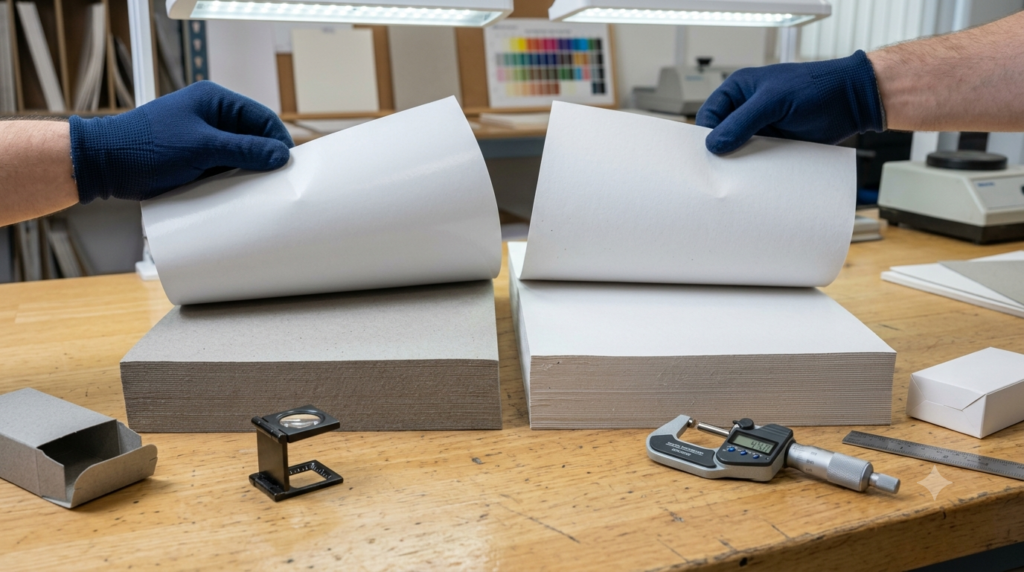
The easiest way to understand the difference is to look at the reverse side of the board.
Grey Back
The reverse side appears grey.
White Back
The reverse side appears white.
But when selecting a board, this colour difference should not be the only consideration.
A professional buyer should also ask:
- What GSM do I need?
- What caliper do I need?
- What stiffness is required?
- What type of printing will be used?
- Is the reverse side visible?
- Is lamination required?
- Is UV coating required?
- Is foil stamping required?
- Is embossing required?
- What folding and creasing performance is required?
- What is the total cost?
Is White Back Duplex Board Better Than Grey Back?
Not necessarily.
This is probably the most important answer in this entire article.
White Back may provide a more attractive reverse-side appearance, but that does not automatically make it technically superior for every application.
For example, if the reverse side of a carton is not visible and the application does not require a white reverse surface, Grey Back may provide a practical solution.
On the other hand, if the inside or reverse side of the packaging is visible and appearance matters, White Back may be more appropriate.
Therefore:
Choose based on application—not simply based on colour.
Grey Back Duplex Board: Advantages
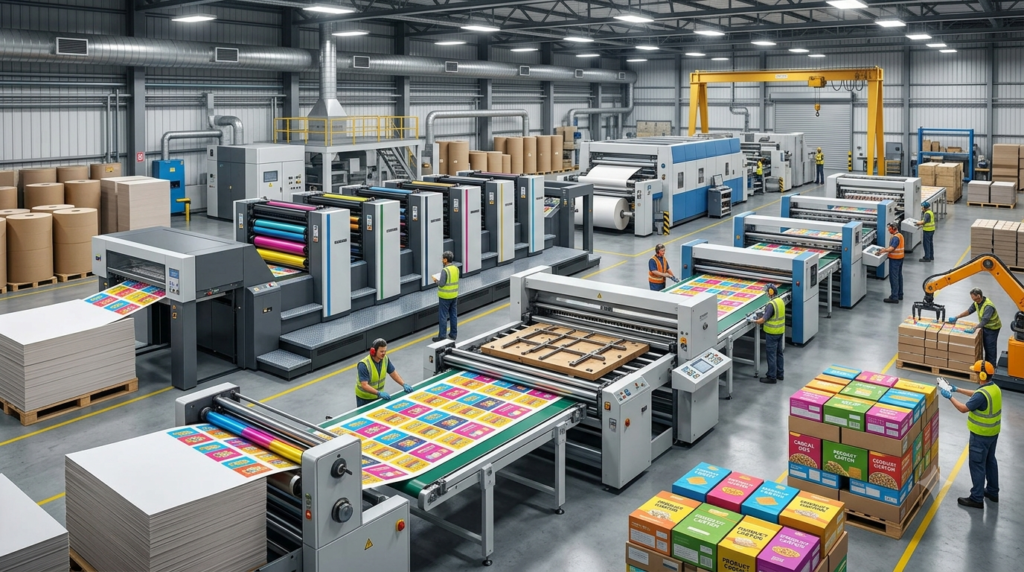
Grey Back can be a practical option for many packaging applications.
1. Cost-Performance Balance
For applications where the reverse-side appearance is not critical, Grey Back can offer a practical balance between appearance, performance and material cost.
Actual pricing depends on the grade, supplier, market conditions and quantity.
2. Suitable for General Packaging
Grey Back is commonly used in general packaging where the grey reverse side is acceptable.
3. Good Printing Surface
Depending on the grade, the coated front surface can be suitable for various printing applications.
4. Wide Application Possibilities
Grey Back can be considered for different carton and packaging requirements.
White Back Duplex Board: Advantages
1. Cleaner Reverse Appearance
The white reverse side provides a cleaner visual appearance.
2. Suitable for Premium Packaging
White Back may be preferred when the inside or reverse side contributes to the appearance of the finished package.
3. Branding and Presentation
For certain packaging designs, a white reverse side can create a more premium presentation.
4. Flexible Application
Depending on the grade, White Back can be used for pharmaceutical, cosmetic, FMCG and other packaging applications.
Grey Back vs White Back for Printing
A common misconception is:
“White Back automatically prints better.”
Not necessarily.
Printing performance depends on the printing surface and board grade, not simply whether the reverse side is grey or white.
Important printing parameters include:
- Surface smoothness
- Brightness
- Whiteness
- Coating quality
- Surface strength
- Ink absorption
- Printability
- Dot reproduction
- Shade consistency
For high-quality printing, the front printing surface should be evaluated carefully.
What About 4-Color, 6-Color and 8-Color Printing?
Duplex board can be used in different printing processes and configurations depending on the grade and printing machine.
For high-quality multi-colour printing, buyers should pay attention to:
- Surface smoothness
- Coating uniformity
- Surface strength
- Ink transfer
- Drying behaviour
- Registration
- Dot reproduction
If a packaging manufacturer is changing from one board grade to another, a printing trial can be useful before approving the material for large-scale production.
Grey Back vs White Back for Cake Boxes
Cake boxes require more than just an attractive printed surface.
The board should provide suitable:
- Stiffness
- Folding performance
- Creasing
- Die cutting
- Printing
- Gluing
- Moisture behaviour
For many cake-box applications, 300–350 GSM may be considered, but the correct GSM depends on the box size, construction and product requirements.
Which back should you choose?
If the reverse side is not important visually, Grey Back may be suitable.
If a cleaner white reverse appearance is preferred, White Back may be considered.
For food-contact applications, the complete packaging construction and applicable food-contact requirements should be verified.
Grey Back vs White Back for Pharma Boxes
Pharmaceutical cartons often require:
- Consistent printing
- Good surface quality
- Folding performance
- Creasing performance
- Dimensional stability
- Consistent shade
- Lot consistency
A White Back may be preferred where the reverse side needs a white appearance.
However, the most important consideration is the approved pharmaceutical packaging specification.
Do not select a board simply because it is White Back.
Check the complete specification and conduct production trials where necessary.
Grey Back vs White Back for Cosmetic Boxes
Cosmetic packaging often focuses heavily on appearance.
Important requirements may include:
- Smooth surface
- High-quality printing
- Brightness
- Whiteness
- Gloss
- Stiffness
- Lamination compatibility
- UV coating compatibility
- Foil stamping
- Embossing
White Back can be attractive for designs where the reverse side is visible.
However, the front printing surface and finishing compatibility remain equally important.
Grey Back vs White Back for FMCG Packaging
FMCG packaging often requires a balance between:
Cost + Printing + Stiffness + Converting + Appearance
For high-volume products, even a small difference in material cost or production efficiency can have a significant impact.
If the reverse side is not important, Grey Back may be a practical option.
If the packaging design requires a white reverse surface, White Back may be more appropriate.
Does White Back Cost More Than Grey Back?
It can, but there is no universal fixed price difference.
Price depends on:
- Board grade
- GSM
- Mill
- Quality
- Quantity
- Market conditions
- Sheet/reel size
- Supply availability
- Customer specification
Therefore, it is better to compare the complete specification and total cost rather than assuming one type is always more expensive.
Don’t Compare Only Price Per Kg
Suppose you receive two offers:
Supplier A: Grey Back – ₹X/kg
Supplier B: White Back – ₹Y/kg
The cheaper price does not automatically mean the better purchase.
You should compare:
| Parameter | Supplier A | Supplier B |
|---|---|---|
| Board type | ✓ | ✓ |
| GSM | ✓ | ✓ |
| Caliper | ✓ | ✓ |
| Stiffness | ✓ | ✓ |
| Moisture | ✓ | ✓ |
| Cobb | ✓ | ✓ |
| Surface quality | ✓ | ✓ |
| Shade | ✓ | ✓ |
| Printing | Trial | Trial |
| Folding | Trial | Trial |
| Die cutting | Trial | Trial |
| Gluing | Trial | Trial |
| MTC | ✓ | ✓ |
| Price | Compare | Compare |
The right board is the one that gives you the required performance and production consistency at an acceptable total cost.
A Simple Decision Guide
Still confused about which one to select?
Use this simple approach.
Choose Grey Back when:
- Reverse-side appearance is not important
- The grey reverse side is acceptable
- The application is cost-sensitive
- The board meets your required technical specification
- Printing is primarily required on the coated front side
Consider White Back when:
- White reverse appearance is important
- The inside of the carton is visible
- Premium presentation is required
- The customer specification calls for a white reverse side
- The selected grade meets your printing and converting requirements
Grey Back vs White Back: A Real-World Example
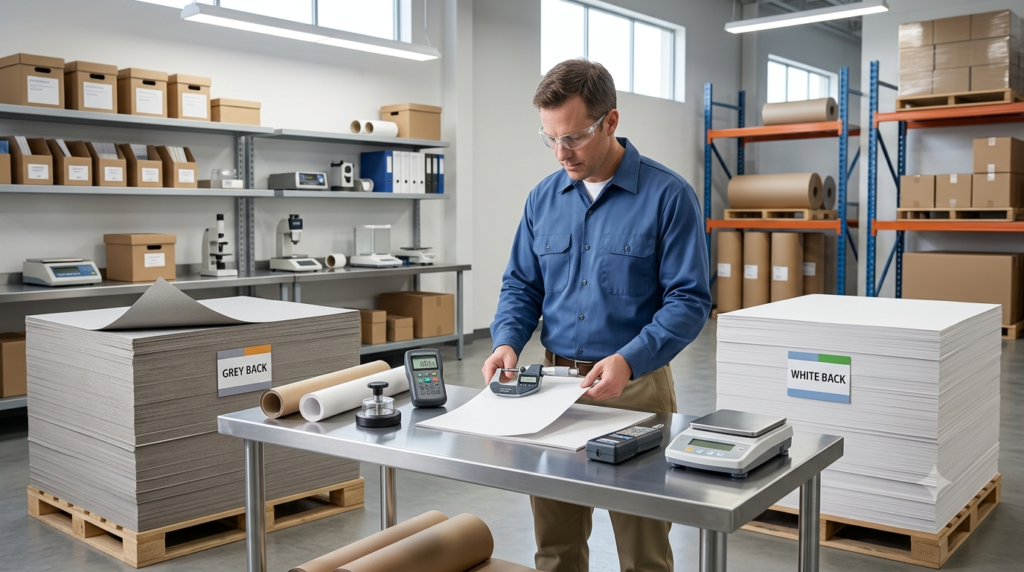
Imagine you manufacture two different boxes.
Product A: Basic FMCG carton
The customer sees only the printed outside of the box.
The inside of the carton is not important visually.
In this case, a suitable Grey Back board may be a practical choice if it meets the required specification.
Product B: Premium cosmetic box
The inside of the box is visible when the consumer opens it.
The customer expects a clean, premium appearance.
In this situation, White Back may provide a more suitable visual finish.
The important point is that the decision comes from the packaging requirement, not from the assumption that one board is always superior.
perform properly during printing and converting.
Frequently Asked Questions
Is Grey Back or White Back duplex board better?
Neither is universally better. The right choice depends on the packaging application, appearance requirements, technical specification and budget.
What is the main difference between Grey Back and White Back duplex board?
The most obvious difference is the colour of the reverse side. Grey Back has a grey reverse, while White Back has a white reverse.
Is White Back duplex board more expensive?
It can be, depending on the grade, mill, GSM, quality, quantity and market conditions. There is no universal fixed price difference.
Does White Back print better than Grey Back?
Not necessarily. Printing performance depends primarily on the printing surface and board grade, including smoothness, coating, surface strength and printability.
Which is better for cosmetic boxes?
White Back may be preferred when a clean reverse-side appearance is important. However, surface quality, stiffness and finishing compatibility are also important.
Which is better for cake boxes?
Both can be suitable depending on the design. Grey Back may work where the reverse appearance is not important, while White Back may be preferred when a white reverse is required.
Which is better for pharmaceutical cartons?
Both can be used depending on the approved packaging specification. Pharmaceutical applications should be evaluated based on the customer’s technical and compliance requirements.
Is Grey Back cheaper than White Back?
Grey Back can offer a cost-performance advantage in some applications, but actual prices vary by grade, mill, GSM, quantity and market conditions.
Can Grey Back be used for printed boxes?
Yes. Suitable Grey Back grades can be used for printed packaging. The printing performance depends on the quality of the coated printing surface.
Can White Back be used for premium packaging?
Yes. White Back can be suitable for applications where a clean reverse-side appearance and good overall presentation are desired.
Grey Back vs White Back: Final Verdict
There is no universal winner.
Grey Back is a practical choice when:
Cost-performance + functional packaging + acceptable grey reverse
is the priority.
White Back is a practical choice when:
White reverse appearance + presentation + customer specification
is important.
But in both cases, the final decision should consider:
GSM + Caliper + Bulk + Stiffness + Surface Quality + Moisture + Coating + Printing + Converting + Application + Total Cost
The best duplex board is not necessarily the most expensive board or the board with the highest GSM.
The best board is the one that performs reliably for your specific packaging application.
Need Help Choosing Grey Back or White Back Duplex Board?
M I Enterprises supplies duplex board for a wide range of packaging applications, including pharmaceutical cartons, FMCG packaging, cake boxes, cosmetic boxes, garment packaging and other printed cartons.
We can help you evaluate your requirement based on:
- Application
- GSM
- Sheet size
- Box size
- Printing requirements
- Finishing requirements
- Quantity
- Required board performance
If you are unsure whether Grey Back or White Back is suitable for your application, share your box application, GSM, sheet size and approximate quantity with M I Enterprises.