
Choosing the right duplex board GSM is one of the most important decisions when purchasing paperboard for packaging.
Many buyers simply select a higher GSM thinking that a heavier board will always be stronger or better. However, this is not always true.
The right GSM depends on several factors, including box size, product weight, board caliper, stiffness, printing requirements, folding, creasing, die cutting and the overall packaging design.
In this guide, we explain how to choose the right duplex board GSM for different packaging applications.
What Does GSM Mean in Duplex Board?
GSM stands for Grams per Square Metre.
It represents the mass of paperboard per square metre.
For example:
- 250 GSM = approximately 250 grams per square metre
- 300 GSM = approximately 300 grams per square metre
- 350 GSM = approximately 350 grams per square metre
- 400 GSM = approximately 400 grams per square metre
GSM is an important specification, but it does not describe the complete performance of a board.
Two different 300 GSM boards can have different:
- Thickness
- Bulk
- Stiffness
- Moisture
- Surface quality
- Coating
- Printing performance
- Folding performance
Therefore, GSM should always be evaluated together with other technical specifications.
Is Higher GSM Always Better?
No.
This is one of the most common misunderstandings in duplex board purchasing.
A 400 GSM board is not automatically better than a 300 GSM board.
For example, if a small pharmaceutical carton is designed for 300 GSM board, moving to 400 GSM may increase material consumption without providing a meaningful benefit for the application.
Similarly, a large box may require higher stiffness and structural performance even if its GSM is not extremely high.
The objective should be:
Choose the right GSM for the application, not simply the highest GSM available.
Common Duplex Board GSM Ranges
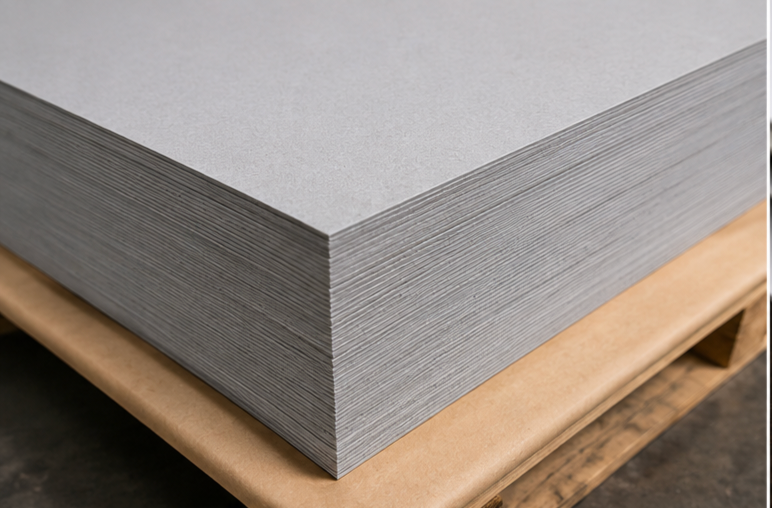
Duplex board is available in different GSM ranges depending on the mill, grade and application.
A practical application-based guide can look like this:
| Approx. GSM | Typical Applications |
|---|---|
| 180–220 GSM | Lightweight cartons and selected applications |
| 230–250 GSM | Small cartons and lightweight packaging |
| 250–300 GSM | Pharma, FMCG and general cartons |
| 300–350 GSM | Cake boxes, FMCG and general packaging |
| 350–400 GSM | Premium and higher-rigidity boxes |
| 400–450 GSM | Heavy or rigid packaging applications |
These are general application ranges, not universal specifications.
The final GSM should be confirmed through the customer’s box design, production process and approved specification.
How to Select Duplex Board GSM?
Before choosing GSM, consider the following factors.
1. Box Size
Box dimensions are one of the most important factors.
A small box may not need the same board specification as a large box.
As the panel size increases, the board may need greater structural performance to maintain the shape of the package.
Therefore:
Small box ≠ automatically low GSM
and
Large box ≠ automatically highest GSM
The correct specification depends on the complete box structure.
2. Product Weight
The product inside the box also matters.
A lightweight product and a heavy product can require different packaging performance.
Consider:
- Product weight
- Product dimensions
- Internal support
- Stacking conditions
- Transportation conditions
- Expected handling
For heavier products, stiffness and structural strength may become more important than GSM alone.
3. Board Stiffness
Stiffness is the resistance of the board to bending.
For many cartons, stiffness is critical because it affects:
- Box rigidity
- Shape retention
- Handling
- Shelf appearance
- Machine performance
This is why a buyer should not compare boards only by GSM.
A better comparison is:
GSM + Caliper + Bulk + Stiffness
4. Caliper or Thickness
duplex board GSM, duplex board GSM, duplex board GSM, duplex board GSM, duplex board GSM, duplex board GSM, duplex board GSM, duplex board GSM, duplex board GSM, duplex board GSM, duplex board GSM, duplex board GSM, duplex board GSM, duplex board GSM, duplex board GSM, duplex board GSM, duplex board GSM, duplex board GSM, duplex board GSM, duplex board GSM, duplex board GSM, duplex board GSM, duplex board GSM, duplex board GSM, duplex board GSM, duplex board GSM, duplex board GSM, duplex board GSM, duplex board GSM, duplex board GSM, duplex board GSM, duplex board GSM, duplex board GSM, duplex board GSM, duplex board GSM, duplex board GSM, duplex board GSM, duplex board GSM, duplex board GSM, duplex board GSM,
Caliper refers to the thickness of the board.
Two boards with identical GSM can have different thicknesses.
For packaging applications, caliper can influence:
- Box feel
- Rigidity
- Folding
- Creasing
- Die cutting
- Stack height
Therefore, when evaluating a new board grade, check both:
GSM and Caliper.
5. Printing Requirements
If the packaging requires high-quality printing, board surface properties become important.
Consider:
- Surface smoothness
- Brightness
- Whiteness
- Coating
- Surface strength
- Ink absorption
- Printability
A high-GSM board with poor surface properties may produce worse printing results than a lower-GSM board with a better printing surface.
6. Folding and Creasing
The board must work properly during converting.
Important processes include:
- Creasing
- Folding
- Die cutting
- Gluing
A board that looks good before production but cracks during creasing is not suitable for that particular application.
Therefore, production trials are valuable when approving a new grade.
7. Product Finishing
Modern packaging may include:
- Lamination
- UV coating
- Foil stamping
- Embossing
- Spot UV
- Special coatings
If these finishing processes are required, confirm the board’s compatibility with the customer’s production process.
GSM Selection for Different Packaging Applications
Pharma Cartons
Pharmaceutical cartons often require:
- Good printability
- Smooth surface
- Folding performance
- Creasing performance
- Dimensional stability
- Consistent appearance
Depending on carton size and construction, approximately 230–300 GSM may be considered for certain applications.
However, the final specification should always be based on the approved customer requirement.
Cake Boxes
Cake boxes require a combination of:
- Stiffness
- Folding
- Creasing
- Printing
- Suitable surface quality
Approximately 300–350 GSM can be considered for many cake-box applications, but box size and construction should determine the final specification.
For food-contact applications, applicable food-contact requirements must also be verified.
Cosmetic Boxes
Cosmetic packaging often focuses on appearance and finishing.
Important factors include:
- Surface smoothness
- Whiteness
- Brightness
- Print quality
- Stiffness
- Lamination
- UV compatibility
- Foil stamping
- Embossing
Approximately 300–400 GSM may be suitable for selected cosmetic box applications.
However, premium appearance does not necessarily require the highest GSM.
FMCG Mono Cartons
FMCG cartons need a balance between:
- Cost
- Printability
- Stiffness
- Folding
- Creasing
- Die cutting
- Production efficiency
Approximately 250–350 GSM can be considered for many FMCG carton applications.
The correct specification depends on the product, carton dimensions and manufacturing process.
Garment Boxes
Garment packaging can require higher rigidity and a good visual appearance.
Depending on the box size and construction, approximately 350–450 GSM may be considered for selected applications.
However, the box design should be evaluated before finalizing the GSM.
250 GSM vs 300 GSM Duplex Board
The difference between 250 GSM and 300 GSM is 50 GSM, but that does not automatically mean the 300 GSM board will perform better in every situation.
250 GSM may be suitable when:
- The package is lightweight
- The box is relatively small
- Lower material consumption is important
- The required stiffness can be achieved
300 GSM may be suitable when:
- More rigidity is required
- The box is larger
- Better structural performance is needed
- The application requires a heavier board
The final decision should be based on actual box performance.
300 GSM vs 350 GSM Duplex Board
This is a common comparison in packaging.
A 350 GSM board provides higher basis weight, but the actual difference in performance depends on:
- Caliper
- Bulk
- Stiffness
- Fibre structure
- Moisture
- Manufacturing quality
If a 300 GSM board provides sufficient stiffness and converting performance, moving to 350 GSM may not always be necessary.
On the other hand, if the box requires additional rigidity, 350 GSM may provide a useful option.
350 GSM vs 400 GSM Duplex Board
For heavier or premium packaging, buyers may compare 350 GSM and 400 GSM.
Before selecting 400 GSM, consider:
Will the additional GSM improve the box?
If yes, evaluate the benefit.
If no, the additional material cost may not be justified.
Also consider whether the higher thickness affects:
- Die cutting
- Creasing
- Folding
- Gluing
- Machine feeding
A board should be selected based on overall production performance, not just weight.
How GSM Affects Cost
Higher GSM generally means more board mass per unit area.
Therefore, if the sheet size remains the same, higher GSM can increase the material weight used for the same number of sheets.
For example, moving from 300 GSM to 350 GSM represents an increase of:
50 GSM
or approximately:
16.7% higher basis weight
assuming the same area.
However, actual packaging cost depends on more than GSM.
Consider:
Board price + GSM + sheet size + yield + wastage + freight + conversion efficiency
This is why comparing only price per kilogram can be misleading.
How to Reduce Cost Without Compromising Quality
A smart buyer does not simply choose the cheapest board.
Instead, the goal should be:
Use the minimum practical specification that reliably meets the packaging requirement.
For example, if a 300 GSM board provides the required:
- Stiffness
- Printing
- Folding
- Creasing
- Die cutting
- Box performance
then using 350 GSM may unnecessarily increase material consumption.
This approach can help improve packaging economics while maintaining quality.
GSM Is Not the Only Quality Parameter
Before approving a duplex board, consider this complete specification:
Basic Properties
- GSM
- Caliper
- Bulk
- Density
Strength Properties
- Stiffness
- Bursting strength
- Ply bond
- Tensile strength
- Tear resistance
Surface Properties
- Smoothness
- Brightness
- Whiteness
- Gloss
- Surface strength
Physical Properties
- Moisture
- Cobb
- Curl
- Dimensional stability
Converting Properties
- Die cutting
- Creasing
- Folding
- Gluing
- Lamination compatibility
- UV compatibility
This gives a much more complete picture of board performance.
Duplex Board GSM Buying Checklist
Before finalizing a GSM, ask:
- What is the box size?
- What product will be packed?
- What is the product weight?
- What printing process will be used?
- Is lamination required?
- Is UV coating required?
- Is foil stamping required?
- Is embossing required?
- What stiffness is required?
- What folding and creasing performance is required?
- What is the approved sample?
- Has the board been production-tested?
- What is the expected monthly quantity?
Once these points are known, the right GSM can be selected more confidently.
Frequently Asked Questions
What GSM is best for duplex board?
There is no single best GSM. The correct GSM depends on the packaging application, box dimensions, product weight, construction and required performance.
Is 300 GSM duplex board good?
Yes, 300 GSM can be suitable for many packaging applications, but suitability depends on the specific board grade and application.
Is 350 GSM stronger than 300 GSM?
Not necessarily in every performance category. Higher GSM means higher basis weight, but actual strength and stiffness also depend on caliper, bulk, fibre structure and manufacturing quality.
Which GSM is best for cake boxes?
Many cake-box applications use around 300–350 GSM, but the final choice should depend on box size, construction, printing, folding and product requirements.
Which GSM is best for pharma boxes?
Many pharmaceutical carton applications use approximately 230–300 GSM, but the correct specification should be based on the customer’s approved carton design and production requirements.
Can I select duplex board only by GSM?
No. GSM should be evaluated along with caliper, stiffness, moisture, surface quality, coating and converting performance.
Final Conclusion
Selecting the right duplex board GSM is about finding the right balance between performance, cost and application requirements.
Do not automatically choose the highest GSM.
Instead, evaluate:
GSM + Caliper + Bulk + Stiffness + Surface + Moisture + Printing + Converting + Application + Total Cost
A correctly selected board can help reduce unnecessary material consumption while maintaining the required quality and performance of the finished package.
Need Help Selecting the Right Duplex Board?
M I Enterprises supplies duplex board for a wide range of packaging applications and helps customers evaluate board specifications based on their actual requirements.
If you are a packaging manufacturer, carton manufacturer, printer, pharma packaging company, cake-box manufacturer, cosmetic packaging company or FMCG packaging manufacturer, share your:
- Required GSM
- Box/application
- Sheet or reel size
- Approximate quantity
- Printing requirements
with M I Enterprises to discuss the appropriate duplex board specification for your application.
M I Enterprises — Duplex Board & Packaging Paper Solutions
Pingback: What Is Duplex Board? GSM, Grey Back & White Back Guide